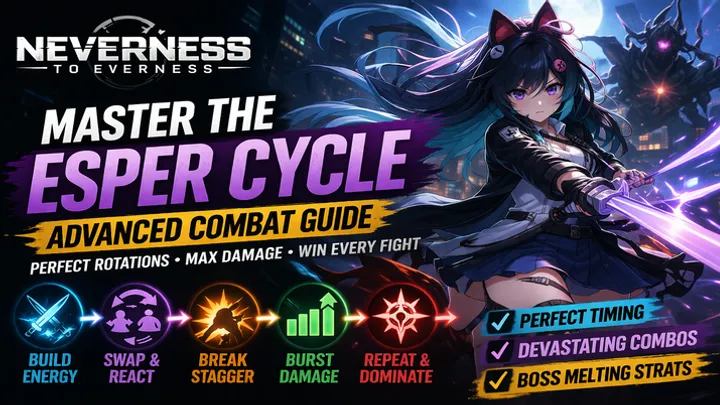







Neverness to Everness is shaping up to be one of the most mechanically layered urban fantasy action RPGs in recent memory, blending stylish real-time combat, fast-paced team swapping, and elemental synergy into one polished system. At the heart of its battle design lies the Esper Cycle—a unique mechanic that transforms ordinary attacks into devastating combo chains when used correctly. The game’s combat revolves around building meter, swapping characters fluidly, triggering reactions, and capitalizing on stagger windows.
While many players will initially approach Neverness to Everness like other action RPG titles, button-mashing through encounters and relying on raw stats, mastering the Esper Cycle is what separates average players from elite players. Understanding how to rotate characters, chain elemental reactions, manage stagger timing, and optimize burst windows can drastically improve performance against bosses and high-level enemies.
This guide focuses entirely on one specific aspect of gameplay: mastering the Esper Cycle combat system for advanced combat efficiency. Rather than general beginner advice, this article provides deep strategic insight into maximizing damage, improving rotation consistency, and using every mechanic in combat to its fullest potential.

1. Understanding What the Esper Cycle Actually Is
The Foundation of Combat
The Esper Cycle is Neverness to Everness’ signature combat mechanic and serves as the backbone of its battle system. It is essentially a layered combo mechanic tied to elemental and character-switching gameplay. Every character contributes to the cycle differently, and understanding how they interact is key to maximizing damage output.
Unlike simpler action RPG systems where players can rely on repeated attacks and occasional skills, the Esper Cycle demands timing, awareness, and sequencing. You are rewarded not just for pressing buttons quickly, but for using them in the correct order.
Why It Matters
Many players underestimate just how much of their damage potential is locked behind proper Esper Cycle usage. Without using it correctly, your team may perform at only a fraction of its intended power. This system is not optional—it is the main strategic layer of combat.
Learning the Esper Cycle early will give players a huge advantage in both PvE encounters and future high-difficulty content.
2. Building Esper Energy Efficiently
Energy Generation Basics
Before you can trigger advanced combat rotations, you need to understand how to generate Esper energy efficiently. The gauge fills through several actions:
- Landing basic attacks
- Using special abilities
- Perfect dodging attacks
- Successful parries
- Triggering reaction chains
Every second you spend not building energy is a second wasted in battle.
Maintaining Combat Momentum
The biggest mistake beginners make is disengaging too often. Backing away from enemies excessively or hesitating between combos causes major drops in energy generation.
To build energy faster:
- Stay aggressive whenever safe
- Keep attacking between cooldowns
- Use dodge offensively, not just defensively
- Punish enemy openings immediately
Mastering energy generation is the first step toward mastering the full combat loop.
3. Creating Team Compositions Around Esper Synergy
Why Team Building Matters
A strong team is not simply four powerful characters placed together. In Neverness to Everness, your team must be built specifically around synergy and rotational compatibility.
The Esper Cycle thrives when characters complement one another in setup, combo extension, and burst timing.
Ideal Team Structure
A balanced combat team often includes:
- One primary DPS character
- One secondary combo extender
- One support or buffer
- One reaction enabler or burst finisher
Each role contributes to keeping the combat flow smooth and uninterrupted.
Avoiding Poor Composition
Do not stack characters purely based on rarity or popularity. A team with weak synergy but strong stats often underperforms compared to a properly built synergistic team.

4. Perfecting Character Swap Timing
Swapping Is More Than Switching
Character swapping is not just a convenience mechanic—it is a core part of the Esper Cycle itself. Swaps allow players to continue pressure, chain combos, and maintain momentum during battle.
Poorly timed swaps can break combos and ruin damage output.
Best Times to Swap
You should swap characters:
- After finishing combo strings
- During enemy stagger animations
- Before long recovery frames
- Immediately after setting up reactions
Swap Discipline
Avoid panic swapping. Randomly changing characters often leads to cooldown waste and broken rotations. Every swap should have a purpose.
5. Maximizing Stagger Before Burst Phases
Understanding Stagger Mechanics
Enemies in Neverness to Everness can be staggered after enough pressure is applied. Once staggered, they enter a vulnerable state and take increased damage.
This is your main burst window.
Setting Up Burst Windows
Do not waste your strongest abilities before stagger unless absolutely necessary. Instead:
- Build enemy stagger meter
- Save ultimates and buffs
- Trigger stagger intentionally
- Unload burst damage during vulnerability
Why This Matters
Using burst before stagger often wastes massive potential. Good players prepare for stagger. Great players plan entire rotations around it.
6. Using Parry as an Offensive Tool
Defensive Mechanics That Increase Damage
Parrying in Neverness to Everness is not merely defensive—it contributes directly to combat momentum by:
- Building Esper energy
- Increasing stagger
- Opening enemies for punishment
- Maintaining offensive flow
Training Your Parry Timing
To improve parry consistency:
- Learn enemy attack patterns
- Watch animation wind-ups carefully
- Practice delayed reactions
- Focus on rhythm rather than panic inputs
The Offensive Mindset
Advanced players stop seeing enemy attacks as threats and begin seeing them as opportunities.
7. Chaining Long Combos Without Overcommitting
The Danger of Greed
One of the most common mistakes in combo-heavy games is overcommitting to long attack strings and getting punished mid-combo.
Neverness to Everness rewards aggression, but reckless aggression is punished heavily.
Safe Combo Strategy
When chaining combos:
- Always keep stamina for dodge
- Never commit if enemy recovery is ending
- Watch for boss phase changes
- Be ready to cancel animations
Smart Play Over Flashy Play
A safe 10-hit combo is always better than a failed 20-hit combo interrupted halfway through.
8. Timing Ultimates Properly in Rotation
Stop Spamming Ultimates Instantly
Many players use ultimates the moment they are available. This is inefficient and lowers total damage output significantly.
Ultimates should align with:
- Buff windows
- Debuff windows
- Enemy stagger states
- Full team rotations
Proper Ultimate Rotation
The best burst sequence generally follows:
- Build energy
- Trigger stagger
- Activate buffs
- Trigger reactions
- Use ultimate finisher
Why Ultimate Timing Matters
A properly timed ultimate can deal double or triple the value of a mistimed one.
9. Adapting Rotations to Boss Mechanics
No Rotation Is Universal
Boss fights will challenge your standard rotation through:
- Movement phases
- Invulnerability periods
- Area attacks
- Interrupt mechanics
How to Adapt
Learn to adjust your combat plan by:
- Delaying cooldowns when needed
- Saving burst for phase transitions
- Holding ultimates during invulnerability
- Prioritizing survival over greed
Flexibility Wins Fights
Top-tier players adapt in real time instead of blindly following the same combo every fight.

10. Building Full Combat Muscle Memory
Practice the Entire Loop
Once you understand every mechanic individually, combine them into one complete combat loop:
- Open with energy generation
- Build Esper gauge
- Setup reactions
- Increase stagger meter
- Trigger stagger
- Buff team
- Execute burst combo
- Use ultimate finisher
- Reset and repeat
Why Repetition Matters
Eventually, combat should become instinctive. You should not need to consciously think through every input.
The best players react naturally because they have practiced enough to internalize every mechanic.
Conclusion
Mastering the Esper Cycle in Neverness to Everness is the defining factor between average and high-level gameplay. While many players may initially rely on flashy attacks and raw damage stats, the true depth of the game lies in understanding how every combat mechanic works together within the Esper Cycle system.
By learning how to generate energy efficiently, build synergistic teams, optimize swap timing, prepare stagger windows, use parries offensively, chain safe combos, and align burst damage with proper rotations, players unlock the full strategic depth of the combat system.
The beauty of Neverness to Everness lies in how interconnected every mechanic feels. Each action feeds into the next, creating a rewarding combat rhythm that emphasizes preparation, timing, and mastery over simple button-mashing.
Players who dedicate time to learning this system will not only deal more damage but will experience combat the way it was truly designed to be played: stylish, strategic, and deeply satisfying.